Japanese painting tradition meets street materials in new exhibition
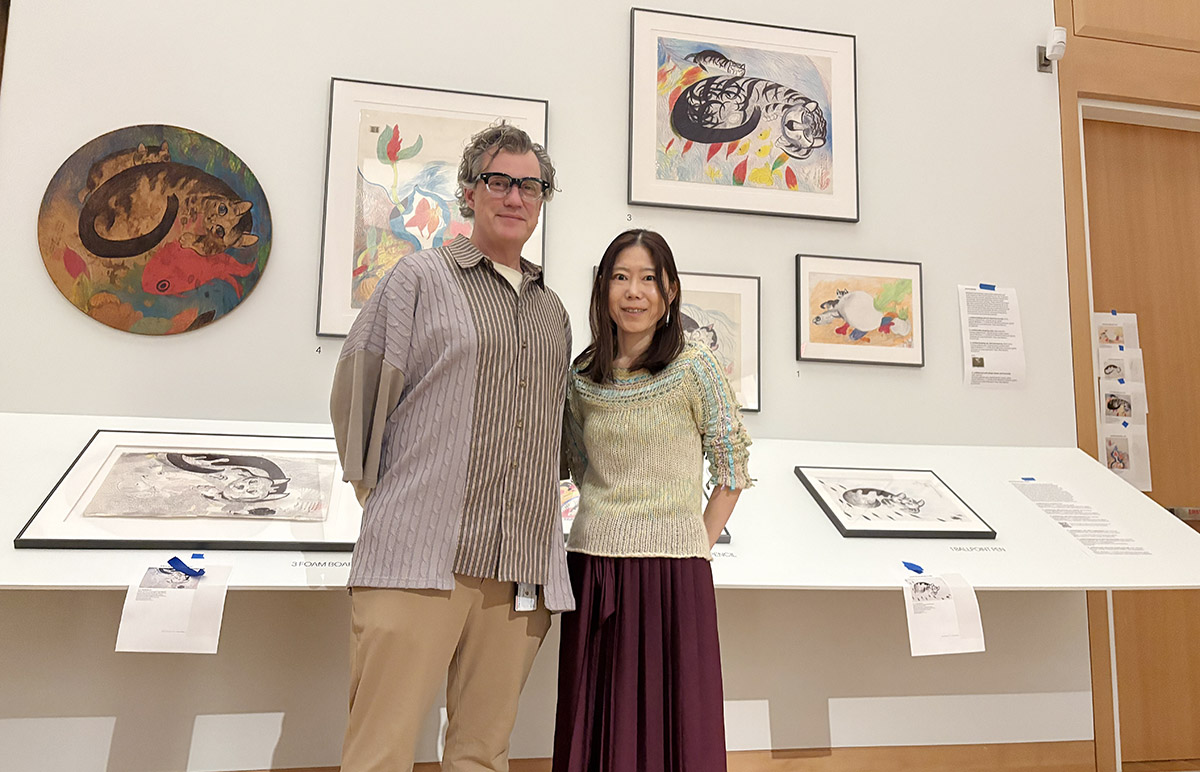
LAWRENCE — Don’t call Jimmy Tsutomu Mirikitani (1920-2012) an outsider artist just because he lived on the streets of New York for more than a decade.
Maki Kaneko, associate professor in the Kress Foundation Department of Art History at the University of Kansas, and Kris Ercums, curator of global contemporary and Asian art at KU’s Spencer Museum of Art, have taken pains in the new exhibition “Street Nihonga: The Art of Jimmy Tsutomu Mirikitani” to note Mirikitani’s training in the traditional-meets-modern style of Japanese art known as Nihonga.
The exhibition of 145 Mirikitani works is the most comprehensive ever and is accompanied by a 228-page printed catalog edited by and with written contributions from Kaneko and Ercums. The curators describe it as a chance to put Mirikitani’s body of work in deep context, telling the story of his migration from his birthplace in Sacramento, California, to Hiroshima before World War II, his return to the United States and subsequent incarceration (1942-1946) in the Tule Lake “War Relocation Center” for Japanese Americans, the loss of family and friends in the atomic bombing of Hiroshima and his later career as a beloved Lower Manhattan street artist who weaved all those experiences into his work.
In the galleries, Mirikitani’s work will be accompanied by short documentary videos created by Linda Hattendorf, close friend of Mirikitani and director of “The Cats of Mirikitani” (2006)
Hattendorf and filmmaker Masahiro Yoshikawa will visit Feb. 20 for a double-feature of their documentaries about Mirikitani and discussion at Liberty Hall. The Spencer Museum also has partnered with the Lawrence Community Shelter on an interactive artwork involving visiting artist Ayomi Yoshida as well as tours of “Street Nihonga” for shelter guests.
Most of the pieces in the show come from Hattendorf’s collection. The Spencer has also acquired some pieces by Mirikitani for its permanent collection.
A 2006 exhibition at Seattle’s Wing Luke Museum curated by KU Department of Visual Art distinguished professor (now emeritus) Roger Shimomura placed Mirikitani’s work in three broad categories: animals and flowers that best paid the bills, political works including incarceration, and collages that told a layered and constantly shifting version of the artist’s life story.
The new show mixes aspects of each of those throughout its six thematic categories:
- Sidewalk Stories
- Street Nihonga
- Tule Lake Memory-Scape
- Multiple Ground Zeros
- Affinities and Connections
- Entangled Memories.
“A guiding principle of the exhibition is that all of these categories are porous, and they can flow into and affect each other, just like a collage,” Ercums said. “We talked about curating the show as a collage, not chronologically, or in these very hard sections, but things can kind of move back and forth between them, because they're all interrelated.”
Some of Mirikitani’s works were framed and matted for the first time for the exhibition, and many have never been displayed publicly.
Kaneko writes in her introduction to the catalog that the work “speaks to pressing social issues that remain relevant today .... imperialism, incarceration, nuclear disaster, 9/11, racism, migration and homelessness. ... one cannot remain a passive viewer. The work demands engagement and ethical reflection.”
After the exhibition closes June 28 at the Spencer Museum, it is scheduled to visit the Museum of Art & University Galleries at the University of Hawai’i at Mānoa and the Mitaka City Gallery of Art in Japan.
The exhibition and associated activities received funding from a number of sources, including the Henry Luce Foundation, the Terra Foundation for American Art, the E. Rhodes and Leona B. Carpenter Foundation, the National Endowment for the Arts, the Helen Frankenthaler Foundation, the Linda Inman Bailey Exhibition and Programming Fund, the Douglas County Community Foundation, George and Hillary Hirose, Margaret Silva and Judy Paley.