Couple’s $1 million gift will add accessible entrance to KU Natural History Museum
LAWRENCE — For many, the University of Kansas Natural History Museum at Dyche Hall is their first introduction to the Lawrence campus. Countless school field trips and family outings have included this rite of passage for young Kansans and other visitors to see not only fossils, a live bee colony and other exhibits, but also the beauty of KU’s campus and all the possibilities it holds.
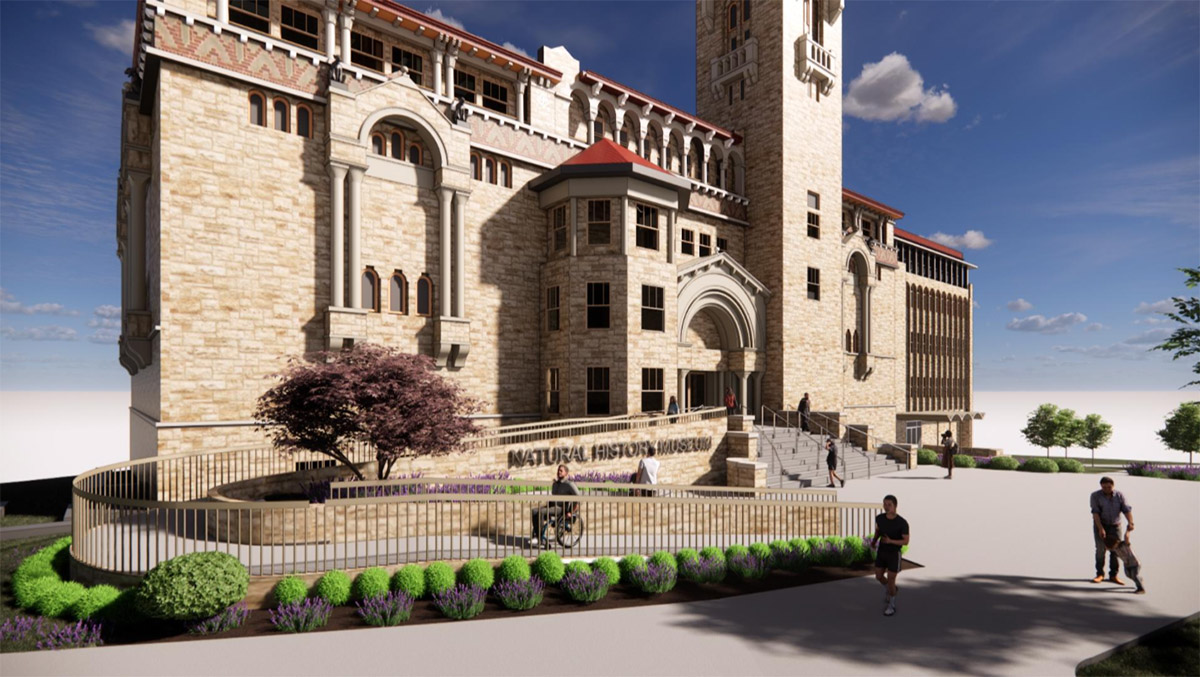
Jann and Tom Rudkin have made a $1 million gift to ensure this portal to KU is as welcoming and accessible as possible, for the benefit of all who visit. Their gift will support the construction of a new accessible entrance from Jayhawk Boulevard to Dyche Hall. Remaining funds after construction will go toward partial restoration of the historic and beloved Panorama exhibit, including taxidermy specimens and other items on display.
“Thank you, Jann and Tom. We are in awe of your gift,” said Nico Franz, professor and Krishtalka Director for the Biodiversity Institute and Natural History Museum. “It is incredibly generous, adding a new dimension to your amazing legacy of KU and museum support. It is also strategic and timely. The new entrance aligns with our mission to provide suitable access to all communities of biodiversity learners and museum visitors that we strive to reach. It builds momentum for us to be bold and further improve the iconic Panorama exhibit.”
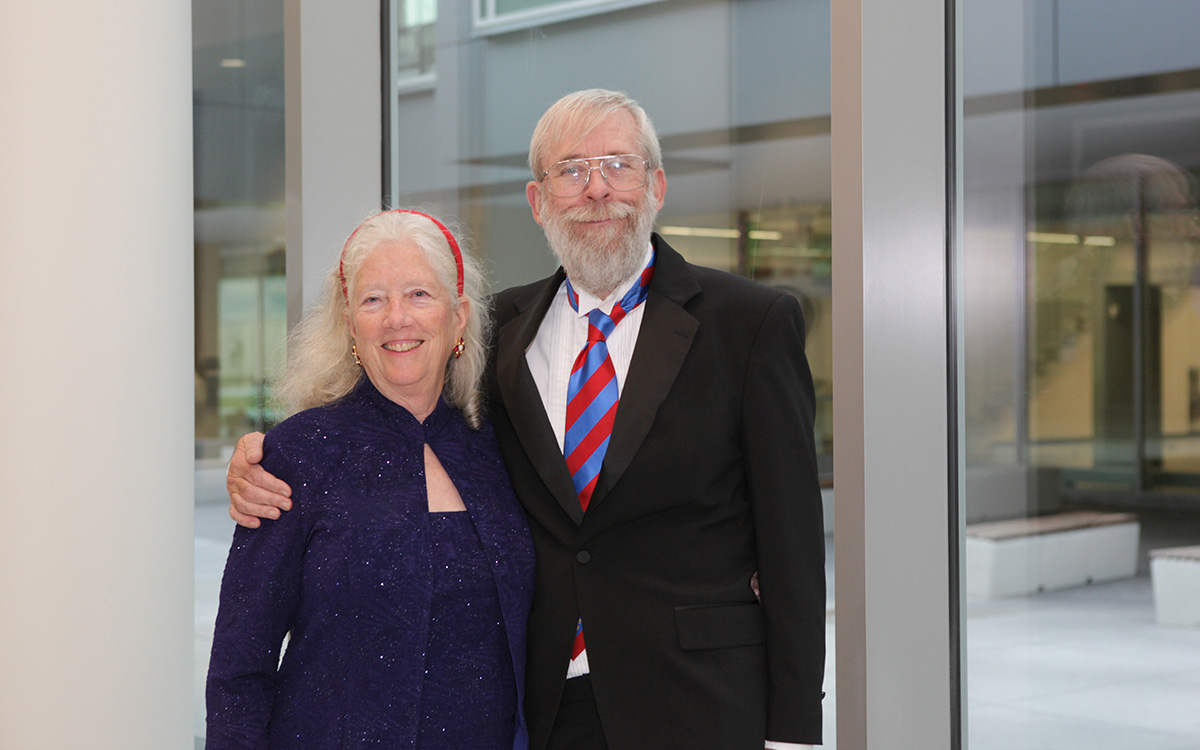
The couple met at KU, and both graduated in 1973. Jann Rudkin’s Bachelor of Art degrees were in anthropology and chemistry, and Tom Rudkin’s Bachelor of Arts was in mathematics. His career as a software development engineer and manager spanned Intel, Bell Northern Research, VisiCorp, Control Data, Forethought and Microsoft.
While at Forethought, Rudkin was one of two developers who wrote the initial version of PowerPoint for Macintosh, released in 1987. He was awarded a Distinguished Alumni Award in 2006 by KU’s College of Liberal Arts & Sciences and a Distinguished Service Award in 2025 by the Department of Electrical Engineering & Computer Science.
Rudkin recalls first visiting the museum as a young boy during a family road trip from Wichita to Iowa. “I can remember stopping through Lawrence and visiting the museum in eighth or ninth grade and thinking what a wonderful place it was,” he said.
Jann Rudkin was a self-employed information designer and now serves on the KU Biodiversity Institute board of advisers, which advocates on behalf of the Biodiversity Institute and Natural History Museum to university, national and international audiences.
Now retired, the two split their time between Lawrence and the San Francisco Bay Area. They are longtime supporters of KU and are museum enthusiasts in general. Their honeymoon even included driving to Chicago to go museum hopping.
“This museum is a cultural institution,” Jann Rudkin said. “This will allow everyone regardless of mobility to experience the museum the way it was meant to be experienced. This is not just a ramp; it is a new beautiful entryway that will draw people in and showcase what a unique building it is.”
The Rudkins were partially inspired by their nephew’s use of a powerchair due to spinal muscular atrophy. They have witnessed the challenges posed by those who visit buildings without equal access, especially buildings as historic as Dyche Hall. The new construction will be in keeping with preserving the unique aesthetic and will be located along the southeast front of the building, leading to the main Panorama entrance. Local limestone is being sourced from quarries to maintain the look and grandeur of the building.
About Dyche Hall
One of KU’s signature buildings, Dyche Hall was built as the Museum of Natural History in 1901-03. The building was named for Professor Lewis Lindsay Dyche after his death (1857-1915). Its first purpose was to house the famous Panorama of North American Mammals he created for the Kansas Pavilion at the 1893 World’s Columbian Exposition in Chicago. The Panorama was unique and revolutionary in depicting, for the first time, preserved specimens of North American mammals in their natural surroundings.
The Panorama has grown over the years to include more habitats and species. It represents the university's early efforts to document and understand past and present life on Earth — research that continues today through the KU Biodiversity Institute.
“The museum is in the process of stabilizing the environment in the Panorama, which prepares us for the next phase of renovation, including repairing and conserving the mounts, landforms and painted murals,” said Lori Schlenker, associate director of collections and facilities. “This will be a complex project as we figure out how to access specimens and murals while working around fragile, historic parts of the display. It is both our responsibility and privilege to be good stewards of this iconic exhibit, and I’m so appreciative to Tom and Jann for their continued support.”
The Biodiversity Institute’s natural history research collections are ranked among the 30 largest globally, with 13 million biological specimens and archaeological artifacts. More than 150 research scientists and students in the institute study biological species, ecosystems, evolution and past human cultures in Kansas and around the world. They use this information to model and forecast environmental phenomena that are critical to human well-being, including threatened and endangered species, the potential spread of diseases and pest species, the effect of climate change on Earth’s biodiversity, habitats and more.
“We want to make the building welcoming because it is an interesting place to visit,” Tom Rudkin said. “But this can also help highlight the vital research that’s ongoing there as well.”
Construction of the new entryway is expected to take place in the summer of 2026.
KU Endowment is the independent, nonprofit organization serving as the official fundraising and fund-management organization for KU. Founded in 1891, KU Endowment was the first foundation of its kind at a U.S. public university.